
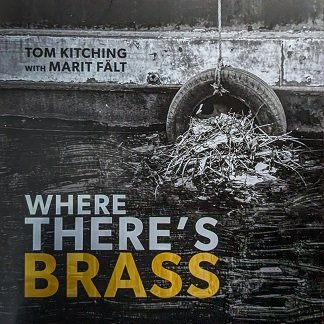
I’ve often said that really good albums are a history lesson, a geography lesson and a biography thrown in for good measure. The full title of Tom Kitching With Marit Falt’s new album is “Where There’s Brass. A Love Letter To The Waterways Of England” and if you’re inclined Tom has penned a book to accompany the instrumental album. The album is dedicated to the much missed Michelle Holding.
I’m going to start with the album, inspired by and partially written on a six month journey from Manchester to London on an old 1930s narrowboat called, Spey. The main reason for that is that the album is capable of doing one thing that on this occasion, I don’t think the written word can, capture the spirit of contemporary life, absorbing and changing a tradition, ensuring that it contributes something new that the next generation can hold and take forward, stagnant water dies.
I listened to the album before reading the book and if you’re getting both I suggest you do the same. I also listened to the album before reading the sleeve notes. What I encountered was an album that seems to be very rich in personality and mood, a blending of shades.
It is instantly tempting to attach the light tunes to the more rural parts of the journey and the darker to the industrial and urban sprawls, but my own, albeit limited experience of the canal and with considerably less of the canal culture, tells me that that would be a false narrative. For practical reasons it is where canal meets urban that the culture has the facilities it needs to flourish and that includes comradeship. The first listen also confirmed my suspicion that this was an album influenced by tradition, rather than beholden to it even if the instrumentation was.
Produced by Jon Loomes and Rakoczy, who also added piano, hurdy gurdy and nyckelharpa, to Kitching’s fiddle and mandolin and Falt’s Mandola and Cittern, “Where There’s Brass” isn’t an album just written for the physical journey from Manchester to the London boating communities it also celebrates friendships and taking time out for other people.
There are very few happy lullaby’s in the world and most of those that are are really just diddling songs, that may explain why on first play, “The Brentford Lullaby” felt a bit darker than it’s contemporaries, subsequent looks at the notes confirmed that this was the tune that picked up on the destruction of canal warehouses in Brentford. Only time will tell how the piece ends, this captures the ground as it’s laid to waste. Perhaps that’s the reason why the final two tracks of the album have more of a lift in them, the canals are still there and stiff full of life, at least in places.
If “Where There’s Brass. A Love Letter To The Waterways Of England” was just an album, I would say that it does the waterways an interesting turn, it stands on it’s own and it stands on it’s own well. If I’m being 100% honest, I’m going to be returning to the album more often then I will the book. That brings me neatly to the book.
I’m really pleased that Tom decided to make the album instrumental, “Where There’s Brass. A Love Letter To The Waterways Of England” is abstract and whilst it references place names in many ways it is more of the love letter than the book. The book is narrative, clearly one six month journey and whilst there is growth and people it’s a book that comes with maps.
There seems to be a truism amongst canal books, no matter how hard you try, no matter how interesting the anecdotes, family stories and the encounters planned and accidental the star of a canal book will always be the boat and that must have really annoyed the horses back in the day.
Over half of the book is dedicated to London, with a wide variety of canal side cultures and conditions. I’m not going to give away the stories, these are for you to explore in the book, but I will say one thing, it’s at the end but not really a spoiler warning as I’ve heard it said elsewhere and pretty much every narrowboat living music I’ve visited has said the same thing, there’s a lot of difference between visiting and holidaying on the canals and living on them, if you’re prepared to be part of a community and work together there’s a life to be had, if you’re just looking for an escape, maybe take a holiday.
“Where There’s Brass. A Love Letter To The Waterways Of England” is both a fascinating book and album, both have massive appeal for two different reasons, Tom Kitching has definitely hit double bubble with both well worth your time.